Kernel logs

So, there I am browsing my logs.

BAM

[650521.310292] INFO: task mysqld:2730 blocked for more than 120 seconds.
[650521.310320] "echo 0 > /proc/sys/kernel/hung_task_timeout_secs" disables this message.
[650521.310364] mysqld        D 00000000     0  2730   2674
[650521.310367]  f6183ce0 00000086 c06ef6cc 00000000 f61c8c70 7834922a 00000dc2 00020050
[650521.310373]  00000296 c0796fe0 c0796fe0 f61c8f04 c2c35fe0 00000003 9500b16e 00024f83
[650521.310379]  00000002 00000002 f66bb500 f6d02e40 c2bf2090 f6e2e680 f6183ce8 c050eb68
[650521.310384] Call Trace:
[650521.310388]  [<c050eb68>] schedule+0x8/0x20
[650521.310391]  [<c0266701>] do_get_write_access+0x2a1/0x3d0
[650521.310395]  [<c0127d93>] ? kmap_atomic_prot+0x43/0xe0
[650521.310398]  [<c0150030>] ? wake_bit_function+0x0/0x60
[650521.310402]  [<c02669a3>] jbd2_journal_get_write_access+0x23/0x40
[650521.310405]  [<c0252a36>] __ext4_journal_get_write_access+0x26/0x60
[650521.310409]  [<c023e9d4>] ext4_reserve_inode_write+0x34/0x70
[650521.310413]  [<c023ea45>] ext4_mark_inode_dirty+0x35/0x140
[650521.310416]  [<c02669ac>] ? jbd2_journal_get_write_access+0x2c/0x40
[650521.310420]  [<c02446cf>] add_dirent_to_buf+0x12f/0x340
[650521.310423]  [<c0245032>] ext4_add_entry+0xe2/0x1d0
[650521.310427]  [<c024540a>] ext4_add_nondir+0x1a/0x70
[650521.310430]  [<c0245814>] ext4_create+0xc4/0x100
[650521.310434]  [<c01d0ced>] vfs_create+0xcd/0x170
[650521.310437]  [<c01d2562>] __open_namei_create+0x42/0xa0
[650521.310441]  [<c01d2be0>] do_filp_open+0x620/0x660
[650521.310444]  [<c01ca888>] ? cp_new_stat64+0xe8/0x100
[650521.310448]  [<c02d3a67>] ? strncpy_from_user+0x37/0x60
[650521.310451]  [<c01c52a1>] do_sys_open+0x51/0xe0
[650521.310455]  [<c01c5399>] sys_open+0x29/0x40
[650521.310458]  [<c0102ebc>] sysenter_do_call+0x12/0x28

Okay, what the hell…Two questions.

Read more →

Playing with dhcpd

Yes! At work today we made dhcpd crash on a /etc/dhcpd.conf :) We were working towards the following (now working) setup:

class "igel" {
	match if binary-to-ascii(16, 8, "-", substring (hardware, 0, 5)) = "1-0-e0-c5-67";
}
pool {
	allow members of "igel"; 
	range 192.84.30.161 192.84.30.170; # igel[0-9]
}

But while figuring this out, dhcpd went boom :)

[root@vmaster cfengine]# dhcpd -d -f -cf hosts/vnet/etc/dhcpd.conf
Internet Systems Consortium DHCP Server V3.0.5-RedHat
Copyright 2004-2006 Internet Systems Consortium.
All rights reserved.
For info, please visit http://www.isc.org/sw/dhcp/
hosts/vnet/etc/dhcpd.conf line 20: can't override match.
    match if 
    ^
hosts/vnet/etc/dhcpd.conf line 22: pool declared outside of network pool
				^
Segmentation fault
Read more →

Using LaTeX with a label writer

I wanted to pretty print my labels on my (new) Dymo 400 label writer. All the howtos I found were detailing how to use LaTeX to print a sheet of labels. But I needed some LaTeX-foo to print only one. So /me to the rescue…

My labels are 36mm X 89 mm (Dymo part #99012) after some trial and error and four misprinted labels I came to the following LaTeX code which fits the text on the labels:

Read more →

Making a library

We (my wife and I) have a lot of books, currently some 637…

$ sqlite3 biblio.db 'select count(*) from books' 
637

But we seem to loose books occasionally because we lend them to people and forget about it. So Linux (and Perl) to the rescue. I already own a bar code reader to read the ISBN number of books and then I use Google to give the author, genre, etc. (fully automated of course).

Read more →

Full file system and I/O redirection

This is an English translation of a blog item I wrote for AT Computing

While giving a course a student showed me the following:

$ ps -ef > /tmp/file

Where /tmp is 100% filled yields no errors and seems to have worked!

Lets try to see what is going on here.

Firstly, lets fill up a file system. We are going to use an fs mounted under /media/disk:

$ cp /dev/zero /media/disk/HUGE                 
$ cp: writing `/media/disk/HUGE': No space left on device 

Further we need a little program to test a few things:

Read more →

2.6.30 and Ubuntu Jaunty

Well, thanks to Ubuntu I’m now running the new (new!) 2.6.30 kernel on my systems.

No ill effects as of yet…

Btw, I’ve written the following script to download the latest kernels from Ubuntu:

SYNOPSIS: latest 29.4, this will fetch 2.6.29.4 or latest 30 which will get 2.6.30.

#!/bin/bash
# download the latest ubuntu mainline kernels
ubuntu="http://kernel.ubuntu.com/~kernel-ppa/mainline/"
version="2.6.$1" # need 29.n as argument
arch="i386"	 # or amd64
major=${version%.[0-9]}
minor=${1%.[0-9]}
patch=${version#2.6.*.}

[ -z "$1" ] && { echo -e "Usage: $0 MINOR\n$0 29.3"; exit 1; }
[ -n "$2" ] && arch="$2"

if echo "$patch" | grep -q '\.'; then
printf -v versionstr "0206%d" $minor
else
printf -v versionstr "0206%d%02d" $minor $patch
fi

printf -v generic "%s-${versionstr}-generic_%s-${versionstr}" $major $major
printf -v all "%s-${versionstr}_%s-${versionstr}" $major $major

echo "${ubuntu}v${version}/linux-headers-${generic}_${arch}.deb"
wget --progress=bar "${ubuntu}v${version}/linux-headers-${generic}_${arch}.deb"
echo "${ubuntu}v${version}/linux-headers-${all}_all.deb"
wget --progress=bar "${ubuntu}v${version}/linux-headers-${all}_all.deb"
echo "${ubuntu}v${version}/linux-image-${generic}_${arch}.deb"
wget --progress=bar "${ubuntu}v${version}/linux-image-${generic}_${arch}.deb"
Read more →

Group policy in Linux

Suppose you want to limit access to some servers, only people member of a specific group (or multiple groups) may log in.

The following is one way to tackle this. In this example I will configure ssh access in such a way that only people from the admin group can login. The nice thing is that this will work regardless of any Kerberos or LDAP usage.

Preparation

In /etc/pam.d find the “service” which you want to add a group policy to. For instance sshd, edit that file (this is with Ubuntu):

Read more →

Kerberos

Mental note to self

Having a host listed in a listprincs output isn’t enough to have single-sign-on working.

You have explicitly add it with ktadd host/your.host.com

So in my case:

# kdadmin.local
....
kadmin.local:  addprinc -randkey host/charm.atoom.net
...
kadmin.local:  quit

And then you can do a (on charm.atoom.net):

% kinit
Password for miekg@ATOOM.NET: 
% slogin elektron.atoom.net

And have a password-less login to my server.

Read more →

Zsh prompt updates

I wanted some git information in the prompt I currently have. While thinking and googling about this, a quote on Bart’s log got me thinking. I don’t need to see my current host, nor do I need to see my current user name.

I always login under my own account (miekg) and if I do change accounts, I probably will be forced to use bash. So showing the current user name is quite useless.

Read more →

DNSSEC deployment

I’ve done some work in the development of the DNSSEC protocol, this culminated (for me) in RFC 4641. At the time I was a big proponent of DNSSEC. I still think the DNS should be improved and also believe DNSSEC is one of the best solutions. I’m however not as sure about this as I once was. This is because of several reasons.

The first one being the development of the NSECn record.

Read more →

Short URLs

Not wanting to miss anything on this short urls business, I’ve implemented something similar in nanoblogger.

How? With a shell script and symlinks, my dear Watson. As with all shell scripting this is probably something you can do drunk.

First I need to get a list of all my articles so that I can link to them. Next I take this permalink address, pipe it through sha1sum, take the last 10 characters and make a symlink from the permalink path and presto: short urls

Read more →

mkfs.ntfs /dev/sdc1

Oh my God — why?? This is a 250 GB disk with a USB2 interface, so I’m in for a long wait apparently.

# mkfs.ntfs /dev/sdc1
Cluster size has been automatically set to 4096 bytes.
Initializing device with zeroes:   4%

It this the Windows-way or is mkfs.ntfs a little bit brain dead?

Read more →

Related articles in nanoblogger

All these wordpress blogs have a related articles line below the blog entries. Sadly nanoblogger does not have such a capability, so I wrote my own. It’s not a plugin in the nanoblogger sense of the word, it may be possible to rewrite it as a regular plugin, but I do not now how…

So for now a simple shell script, which you can find here.

Usage within a template

In your templates you should include the following:

Read more →

KDE XFCE rocks

I could not agree more with Christoph Haas.

I’ve tried KDE briefly during the last 6 months or so, but it never really stuck.

Some observations.

  1. I’ve bought an EeeBox (Dual Atom, with 1 GB of ram), boy, how slow is KDE. Do I really need a Vista capable machine to run KDE?

  2. I like my current (XFCE) desktop. Why? Because it’s nice and clean. I have no use for desktop icons. I have no use for fancy clocks running on my desktop. I have no use for any fancy stuff running on my desktop. Why?

Read more →

Resize RAID1 array without knowing which disk is which

I want to grow my RAID1 array from 2x250GB to 2x500GB. The following resource has helped my a lot.

Update

It all worked, allthough the kernel decided to crash during the offline ext4 resize. But I finally have my extra disk space

% df -h | grep md6

before: /dev/md6 77G 67G 6.7G 91% /vol

after: /dev/md6 306G 67G 224G 23% /vol

Now to my problem/solution:

On Linux you often have the following problem: You are looking or touching some piece of hardware and you are asking yourself: “is this card eth0 or eth1?” or “is this disk /dev/sda or /dev/sdb?”.

Read more →

My First Linux

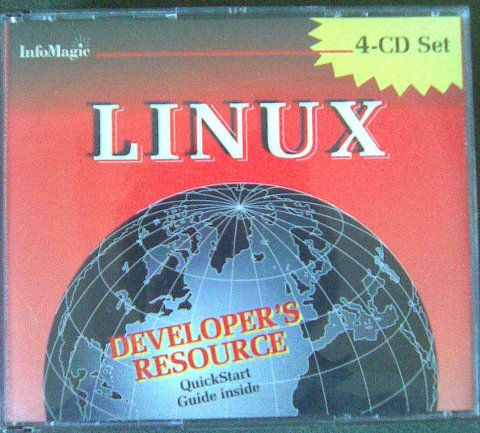
I’ve always kept my first Linux CDs as a reminder of that great time when I was first exploring this unexplored territory.

These are two (bad) shots of the actual CD, maybe I should put the content of them online again? Kernel version 1.2.8, gcc version old, non working X on the default install, that kind of stuff… I was hooked forever to this stuff.

Infomagic CD screenshot

Infomagic CD side screenshot

Read more →

Oracle and OpenSolaris

I’ve never like (Open)Solaris. Maybe the kernel rules, but the userland completely sucks, something like apt should have been implemented in (Open)Solaris years ago.

Now that Oracle owns SUN and thus Solaris they should rebrand it. Maybe OpenSoracle or even OpenSorry.

Read more →

Ubuntu, LUKS disk encryption

Found this very nice howto, which I almost followed to the letter, except I did it in Ubuntu and currently more stuff is working out of the box, so you don’t need to do all the steps.

I’m working on an USB stick which is /dev/sdb1 in my system.

Steps I did take:

  1. apt-get install cryptsetup hashalot
  2. cryptsetup --verbose --verify-passphrase luksFormat /dev/sdb1
  3. cryptsetup luksOpen /dev/sdb1 funnydiskname
  4. mkfs.ext4 -O extents,uninit_bg,dir_index /dev/mapper/funnydiskname
  5. cryptsetup luksClose /dev/mapper/funnydiskname

Now pull out your disk and re-insert. If everything went well, your GNOME, XFCE, KDE env should now popup an ‘This disk is encrypted, please enter the passphrase’ question.

Read more →

Coding Erlang

For the past year or so I’ve been trying to learn a new language called Erlang.

I’ve found this nice document, which can be used when learning the language. So here I am on Saturday evening doing some Erlang exercises :-)

Anyhow, I was doing exercise 3.4:

  1. Erlang provides a function lists:append which joins two lists together, implement you own function append that performs the append operation. (Do NOT peek; the answer is given in figure 3.11).

And the answer given is:

Read more →

/proc/sys/kernel/pid_max

In kernel version 2.6.29.1:

# /bin/echo -n 40000 > /proc/sys/kernel/pid_max 
/bin/echo: write error: Invalid argument

In one older kernel I tried it still worked, so I’ve submitted a bug.

Read more →

OpenLDAP 2.4 cn=config

OpenLDAP uses a cn=config DIT to configure the server since version 2.4. I’m always into new stuff, but I must admit that I rather liked editing /etc/ldap/slapd.conf to configure the server. Anyhow being able to store ACLs in the tree is a big plus, but for configuring minor stuff (like indexes) it makes live more difficult.

The following site was an excellent tool in helping me configure OpenLDAP. For a list of current attributes names, see for instance here

Read more →

LVM: good, LVM snapshots: bad

Well, today I was looking into using LVM snapshots to allow a client OCN use Linux as a Netapp replacement…. Boy was I in for a disappointment.

LVM an sich is working great, but the moment you turn on snapshots the (in this case) write performance goes to hell. Using LVM is easy enough. The system I was on has 32 GB ram and 2 disk arrays with hardware RAID.

Setting up:

Read more →

Linux networking bonding

See this?

bond0: Warning: failed to get speed and duplix from eth*

Do this:

insmod bonding miimon=100

why?

When using Linux network bonding the kernel may be to quick to enslave the interfaces. When an interface is too slow to report it capabilities it will be set to 100Mbit and Full Duplex. Which is a bit sad when you have 6 Gigabit network cards…

Read more →

vim text objects

For a few weeks months now I’m learnings how to use VIM text-objects. There is an extended help wth help text-objects in VIM. I’m trying to condense the VIM help in a smaller blog entry here.

What are a text-objects in vim? Text-objects are things like a ‘paragraph’ or the text between braces or something like a word. Text-objects can be used with the normal vim commands y, d and c. To make you really understand it, I can recommend using control-V to actually visually select your text object.

Read more →